Meta Ads for Hotels India | Boutique Resort Case Study | StayStream
See how Meta Ads for hotels in India drove direct bookings for a Kerala boutique resort — real campaign structure, budgets, and 90-day results.
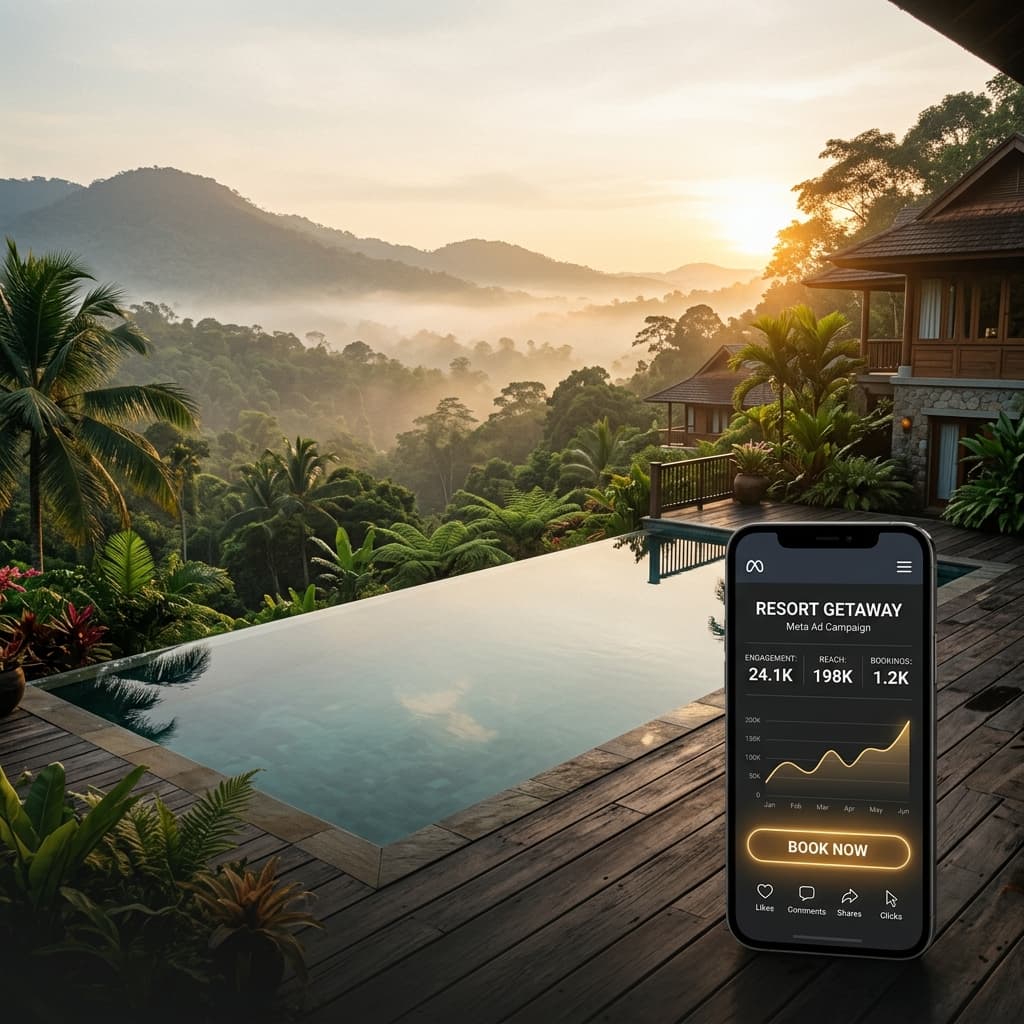
Meta Ads for Boutique Resorts — What Works in India
A real campaign breakdown for Kerala resort owners: audience structure, budgets, and 90-day results
By StayStream Hospitality · Paid Social · Case Study · Kerala · India
If you manage or own a boutique resort or homestay in Kerala, chances are your marketing budget is small, your team is thin, and your OTA commissions are eating into every booking you get. As a hotel marketing consultant Kerala properties increasingly turn to for this exact problem, I get asked the same question every week: "Does Meta Ads for hotels India actually work, or is it just spend with no return?"
This post walks through a real campaign structure — audience layers, budgets, creative approach, and 90-day results — from a boutique resort case study in Kerala, so you can see exactly what worked and what didn't.
Why Meta Ads Matter for Boutique Hotels in India
Most independent hotels and resorts in Kerala rely on OTAs for 70–85% of their bookings. That dependency comes at a steep price — commissions of 15–25% per booking, no control over guest data, and constant rate pressure from the platform. Every conversation about how to reduce OTA commission hotel India properties struggle with eventually comes back to the same answer: build a direct channel that can compete on visibility with the OTAs.
Meta Ads (Facebook and Instagram) is one of the fastest and most affordable ways to do that, because it lets a small property reach exactly the traveller planning a Kerala trip — at a fraction of what OTA commissions cost over a guest's lifetime value.
Why this matters
A boutique resort paying ₹4,500 average commission per OTA booking can often acquire the same direct booking through Meta Ads for ₹800–1,200 in ad spend — and keep the guest's contact details for repeat marketing.
The Boutique Resort Case Study — A Kerala Property
The property in this case study is a 14-room boutique resort in Kerala (details anonymised at the owner's request). Like most independent resorts we work with through our hospitality consulting Kerala engagements, the owner had a well-reviewed property, strong photography, but almost zero direct booking strategy hotel India properties need to compete online. Over 80% of bookings came through two OTAs, and the resort had never run a paid social campaign.
The Starting Point
- 78% of bookings from OTAs, 22% from repeat/referral guests
- No pixel or conversion tracking installed on the website
- No retargeting audience or email list being built
- Average OTA commission: ₹4,200 per booking
The Goal
Increase direct bookings boutique hotel owners could see reflected in real revenue within one quarter — without cutting into rates or running discount-only offers that would train guests to wait for deals.
Campaign Structure That Worked
Objective and Funnel
We ran a three-stage funnel rather than a single "boost this post" campaign, which is the single biggest reason most hotel Meta Ads spend underperforms:
- Stage 1 — Awareness: Reels and carousel ads showcasing the property to broad Kerala/South India travel audiences
- Stage 2 — Consideration: Retargeting website visitors and video viewers with room-specific and experience-specific ads
- Stage 3 — Conversion: Retargeting warm audiences (website visitors, Instagram engagers) with a direct-booking offer and urgency messaging
Audience Targeting Layers
- Cold audience — Interest + lookalike targeting (South India travellers, age 25–55, sourced from Bangalore, Kochi, Chennai, Trivandrum). Objective: Reach and video views.
- Warm audience — Website visitors (30/60/90-day windows) and Instagram/Facebook page engagers. Objective: Traffic and lead generation.
- Hot audience — Booking-page visitors and add-to-cart abandoners who didn't complete a reservation. Objective: Conversions.
Creative Approach
Static photos alone underperformed. The best-performing creative was short-form video — 15 to 30 second Reels shot on a phone showing the property's misty valley views, breakfast spread, and a walkthrough of the most popular room category. Carousels ranking amenities (pool, forest views, Ayurvedic spa) also performed well for the consideration stage.
Budget Allocation
On a total monthly budget of ₹25,000, the split looked like this:
- Awareness: 40% (₹10,000)
- Consideration / Retargeting: 35% (₹8,750)
- Conversion: 25% (₹6,250)
Results — 90-Day Performance
- Direct bookings (monthly): 6–8 before → 19–22 after
- OTA share of total bookings: 78% before → 58% after
- Average cost per direct booking: N/A before → ₹1,050 after
- Monthly ad spend: ₹0 before → ₹25,000
- Return on ad spend (ROAS): N/A before → 6.4x
- Email/WhatsApp list built: 0 before → 410 contacts
The most important number here isn't the ROAS — it's the OTA share dropping from 78% to 58% in one quarter. That shift alone saved the property roughly ₹95,000 in commission over 90 days, more than 3x the total ad spend for the same period.
What Didn't Work
- Boosting Instagram posts directly from the app — no audience control, poor tracking, wasted budget
- Discount-led ad copy — attracted price-sensitive bookers who later cancelled or haggled on arrival
- Running ads without a pixel installed — the first three weeks of spend were essentially unmeasured and had to be treated as a write-off
- Sending ad traffic straight to a generic homepage instead of a dedicated offer or booking page
How Meta Ads Fit Into a Full Digital Marketing Strategy
Meta Ads on their own rarely fix a direct-booking problem — they work best as one layer of a broader hotel digital marketing agency Kerala approach. In this case, three other pieces had to be in place before the ad spend could convert efficiently:
- Hotel website development Kerala teams should prioritise a fast, mobile-first booking flow — ad traffic sent to a slow site or a clunky booking widget simply bounces
- Google Ads for hotels India campaigns captured the high-intent searchers actively typing "resorts in Kerala" or similar terms, complementing the Meta funnel's broader reach
- OTA optimisation hotel India work — including tightening photos, descriptions, and following the same Booking.com ranking tips India properties use to protect visibility — continued in parallel, since OTAs still matter even as direct share grows
- Ongoing hotel revenue management Kerala practices ensured rates stayed consistent across OTA and direct channels, so the ad spend wasn't undercut by rate parity issues
This is the same integrated approach we apply across every resort marketing agency Kerala engagement — paid social, search, website, and revenue strategy working together rather than as isolated tactics.
Meta Ads Checklist for Boutique Hotels and Resorts
Before you spend a single rupee on Meta Ads: Install the Meta Pixel on your website → build a dedicated booking landing page → film at least 5 short vertical videos → set up a 3-stage funnel (not a single boosted post) → track cost-per-booking weekly, not just reach or likes.
Frequently Asked Questions
How much should a boutique hotel budget for Meta Ads in India?
Most boutique properties see meaningful results starting at ₹20,000–30,000 per month, split across the three funnel stages above. Below that range, there usually isn't enough data volume for Meta's algorithm to optimise efficiently.
Do Meta Ads work better than Google Ads for hotels?
They serve different purposes. Google Ads for hotels India campaigns capture travellers already searching for a property like yours — high intent, but limited by search volume. Meta Ads build awareness and consideration among people who haven't started searching yet, which is essential for lesser-known boutique properties. The strongest direct booking strategy hotel India owners run typically uses both channels together.
Can Meta Ads actually reduce OTA commission dependency?
Yes, but gradually. As shown in this case study, a well-structured campaign shifted OTA share from 78% to 58% in one quarter. It won't eliminate OTA dependency overnight, but every percentage point shifted to direct booking is commission saved permanently.
Is this approach specific to one region, or does it work for resorts across Kerala too?
The framework is the same across Kerala and South India. As a hotel marketing agency, properties across the state work with us on — we adjust the audience geography and creative locations — but the funnel structure, budget logic, and tracking setup stay consistent.
Ready to Reduce Your OTA Dependency?
StayStream Hospitality is a hospitality consulting India resorts, boutique hotels, and homestays trust for direct booking growth, Meta Ads, Google Ads, and full-funnel hotel digital marketing India strategy. Book a free strategy call and we'll audit your current OTA-to-direct mix.
Related Articles
- How to Reduce OTA Dependency for Hotels in India — The complete 12-month strategy for shifting bookings from OTA to direct.
- Google Ads for Hotels India: Step-by-Step Setup Guide — Pair Meta's reach with Google's intent-capture to build a full direct booking funnel.
- Hotel Revenue Management Kerala: A Guide for Small Resorts — Ensure your pricing strategy supports — not undermines — your paid social campaigns.
- Hotel Website Development Kerala: What Your Site Needs Before You Run Ads — Fix the conversion endpoint before investing in ad spend.
What does your channel mix actually cost you?
We offer a 20-point Revenue Audit for independent properties in Kerala — a clear view of your current channel mix, what it costs net of commission, and where the real opportunities are.
Or browse our case studies to see how we have helped similar properties.